


Types of Bungee Jumps
Ways to Jump
- Body Harness
The most common ways to attach yourself to the cord are by using a body harness or a leg harness. If the only way of connecting yourself to the cord is a body harness you should have at least a sit harness and a shoulder harness, or a full body harness (see the harnesses section). Jumping with just a sit harness is not recommended.If you are jumping with just a body harness you are afforded quite a bit of freedom to move around, you arms and legs are free to flail around. The cord will be attached to a point close to your belly (your center of gravity), making spins and flips easier. As you jump you can do many flips on the way down if the jumpmaster holds the spare cord and releases it when you jump (this is called 'spotting', the jumpmaster being the spotter).
- Leg Harness
The leg harness comes in different styles. Some let you jump with just one leg harnessed, but most with both. You should always have a backup harness when using leg harnesses, usually just a normal climbing sit harness. This is especially important if you are to be brought back up to the jump point since being brought up upside down is uncomfortable.The leg harness can really give you the feeling of flying and is the best ground rush there is (especially for water touchdowns). While you are rebounding, if you are at the right angle, you can tuck at the top and flip right over for another beautiful swallow dive for your second fall.
It is important when jumping with a leg harness that when the cord becomes tight your body is facing along the line of the cord, otherwise you will get thrown around quite a bit (and maybe even break your ankles).
- Arm Harness
It is possible to jump with a harness on your arms; which is usually just a reglar leg harness. Your arms are not usually used to support your whole body weight, so this could easily lead to dislocated shoulders etc... Jumping with an arm harness is not recommended. - Swallow Dive
By far the best way to jump - just take a nice leap away from the platform, arms stretched out wide and soar like a bird down towards the earth. By the time the cord starts to stretch you should be pointing straight down and the deceleration should be very smooth.If you are jumping with just a body harness connected at the front you will need to rotate even more in the air so that when the cord becomes taut you will be facing upwards.
- Back Dive
Slightly harder than a swallow dive to get right since many people that try it lean back a little, but end up falling feet first. You must really throw yourself into it so that at the bottom of the fall you are pointing towards the ground. If you are jumping with just a body harness connected at the front you will need to either just drop backwards or rotate even more in the air so that when the cord becomes taut you will be facing upwards again. - Railing Jump
This is most common when jumping off bridges with a railing. Instead of climbing over the railing, you climb onto the railing. Two people stand behind you with their arms up and hands in a fist: By holding onto them you can balance right on the edge of the railing and then jump from there. - Top of Cage
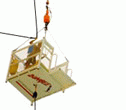
Like a railing jump, but when you jump from a cage below a crane, climb on top of the cage and jump from the top. It really doesn't buy you that much more and the chances of accidents are high. - Bat Drop
You maneuver yourslef so you are hanging upside down with your toes (or someone else) holding you to the jumping platform, then you just drop like a rock straight down. - Elevator (aka Pile Driver on Mil. Spec cord)
Like an inverted bat drop; just jump from the platform with your feet pointing down. When you get to the end of the cord, you will be flipped the right way round. With an all rubber (Euro/Kiwi) cord this is bearable; with Mil. Spec it will almost certainly hurt a lot (hence the Pile Driver name), and you could even break your ankles). - Pogo
When you jump with ankle harnesses, it's possible to end up so that you are standing on your ankle harnesses, holding onto the cord at the end of your jump. Most jumpmasters don't like you touching their cord, so make sure they know you're going to do this. Plus grabbing the cord is always dangerous, if you're lucky, you'll end up with rope burns on your hands. If you're unlucky, you could easily break your arms, wrists or fingers. - Thrown
Instead of jumping, why not get a gang of friends to throw you from the bridge! Check out these photos from Over the Edge Bungee in Idaho, or these from Icarus Bungee. - Water Touchdown
Many sites are so confident that they can judge how much the cord will stretch that they offer water touchdowns. You jump as normal, but at the bottom you will go into the water. This is best attempted over DEEP water (see this disaster).The way you jump affects how much the cord will stretch, and whether there is a spotter (someone dropping the cord beside you). If you jump far away from the bridge you will drop less than if you were to jump straight down.
- Cutaway
You can be facing forwards or backwards to feel the rush of a cutaway. A piece of webbing is tied to the platform and then to your waist so that you are leaning out at 45 degrees from the platform (you can be facing either up or down at this point). Make sure you are looking straight up or down and NOT at the webbing. The webbing is then slowly cut; eventually it will break, sending you plummeting to the ground. However you won't quite know when it will happen. - Tandem
Two jumpers jump at the same time. This is actually pretty dangerous since it's very easy to bang heads at the bottom or just get tangled up in each other. Plus the weight of two people are not the 'norm' that clubs are used to dealing with so there can always be errors made when selecting cords and harnessing.There is also the chance of one person jumping and the other not, but since you're attached the 'chicken' will just get dragged down (and then bang heads at the bottom). This was well documented on video from MTV's Real World.
- Sandbagging
This is EXTREMELY DANGEROUS, and you really shouldn't try it, but I'll explain it here. You jump holding a heavy weight; once you get to the bottom of the drop, you let go of the weight. All of the extra elastic energy the weight put into the cord is now transferred to you, making you fly MUCH higher than the place you jumped from.It's important to consider that you will fly back toward what you jumped from, which is usually pretty solid. Hence, you could fly back into the platform at great speed! If you jump from the opposite side of a bridge (opposite to the side the cord is attached) you may bounce back above the bridge (if you are lucky).
You need to account for your weight and the weight of the sandbag when working out what cord to use. Since subsequent rebounds will be just you (on a cord designed for a heavier weight), they will be pretty harsh. Plus, you must make sure you can hold onto the sandbag until the end of your first drop.
Some people actually use another person as the 'sandbag'. Dropping the sandbag/person early or late has even more serious consequences in this scenario. As demonstrated on an MTV show where they couldn't hold on the whole way and the sandbag guy dropped early (Bungee'd without the cord) and broke his ribs and arm.
Types of Bungee
- Bungee Jump
Just your regular old bungee jump. You jump (perhaps in one of the ways described above) and then rebound several times giving you about 2 to 4 great feelings of weightlessness. - Catapult
This is similar to bungee jumping except that you start on the ground. The cord is stretched away from you; when the cord is stretched you are released from the ground. You shoot up into the air at approximately a gagillion miles per hour, eventually stoping and continuing like you would any normal jump.Since the nature of the cord is to pull you towards wherever it is fixed, there is considerable danger that you could shoot into the anchor for the cord (usually a crane cage).
Catapult is also known as "Reverse Bungee" and "Bungee Rocket".
- Twin Tower
Very similar to a catapult, but they have solved the problem of running into the cord anchor. There are two towers, each with a cord leading to you (in between); the cords are stretched, and you are relased. Since both cords are pulling you, you shoot straight up and then bounce around.Some places use this technique, but you are strapped into a metal cage, and this requires much stronger bungee cords. One company that offers this is Bungee Adventures; they call it the Ejection Seat.
- Bungee Run
This isn't 'jumping' per se. The object of bungee running is to run as far away as you can, while a bungee cord pulls you back, eventually you can't pull any more and you give up and get dragged back to where the cord is anchored (as is the way with bungee cords). Usually the bungee run is in a big inflatable (bouncy castle), however it has been known to be right in the middle of a bar with not much to protect you at all. - Snow Bungee Canoe
This is pretty far out there and I'm sure no one really does it, but I found it so hilarious when I learned about it, I had to include it here. I saw it on a TV show in America; it was based on the lives of some mountain rescue people in Colorado I think (kind of like Northern exposure, but based on a mountain rescue team).Anyway, these stoner adrenaline junkies hiked all the way upto the top of a mountain, with their bungee cords and a canoe. They attached one end of the cord to the canoe and the other to the top of the mountain. They all climbed into the canoe and shot down the mountain with the cord behind them.
Upon reaching the end of the stretch of the cord, three of them fell out - leaving one poor sucker in the canoe. Just like sandbagging the extra force in the canoe from the three ejected people shot the canoe and sucker at mach 3 UP the hill. Upon reaching the top, the canoe was still moving at a fair old speed and shot right over the top and when it finally came down it was dangling from the cord on a vertical cliff.
Cue hero rescue types for another enthralling show...
This section is still under development! More will be coming soon, but here is a taste of what is to come. If you would like to submit content for any of the titles below, please just email them to webmaster@bungeezone.com
Things to Jump From
- Cranes
the cage is on the ground
jumper is connected to cord which is connected to cage
sometimes jumpmaster holds the coils of the cords
the crane lifts up the cage and jumper
jumper jumps from cage and bounces
crane slowly lowers cage until jumper is close to ground
ground crew catch jumper
crane lowers cage to the ground - Bridges
jumper is at top of platform or bridge
jumper is connected to cord, cord is connected to bridge
jumper jumps from bridge and bounces around
either:
- a static line is lowered to the jumper who clips it on and jumper is pulled back up to the bridge/platform. (Safest)
- the cord is pulled up via a static line a short
distance, disconnected from the bridge and then the
jumper and cord is lowered to the ground at the bottom
of the bridge
- Buildings (with platforms)
- Towers
- Hot Air Balloons
- Helicopters
- Cable Cars
Related but not quite Bungee
- Bridge Swinging
Called 'puenting' in Spain - Scad Diving
- Zorbing